
How to Start a Medical Coding Career Without a Biology Background (An Honest 2026 Roadmap)
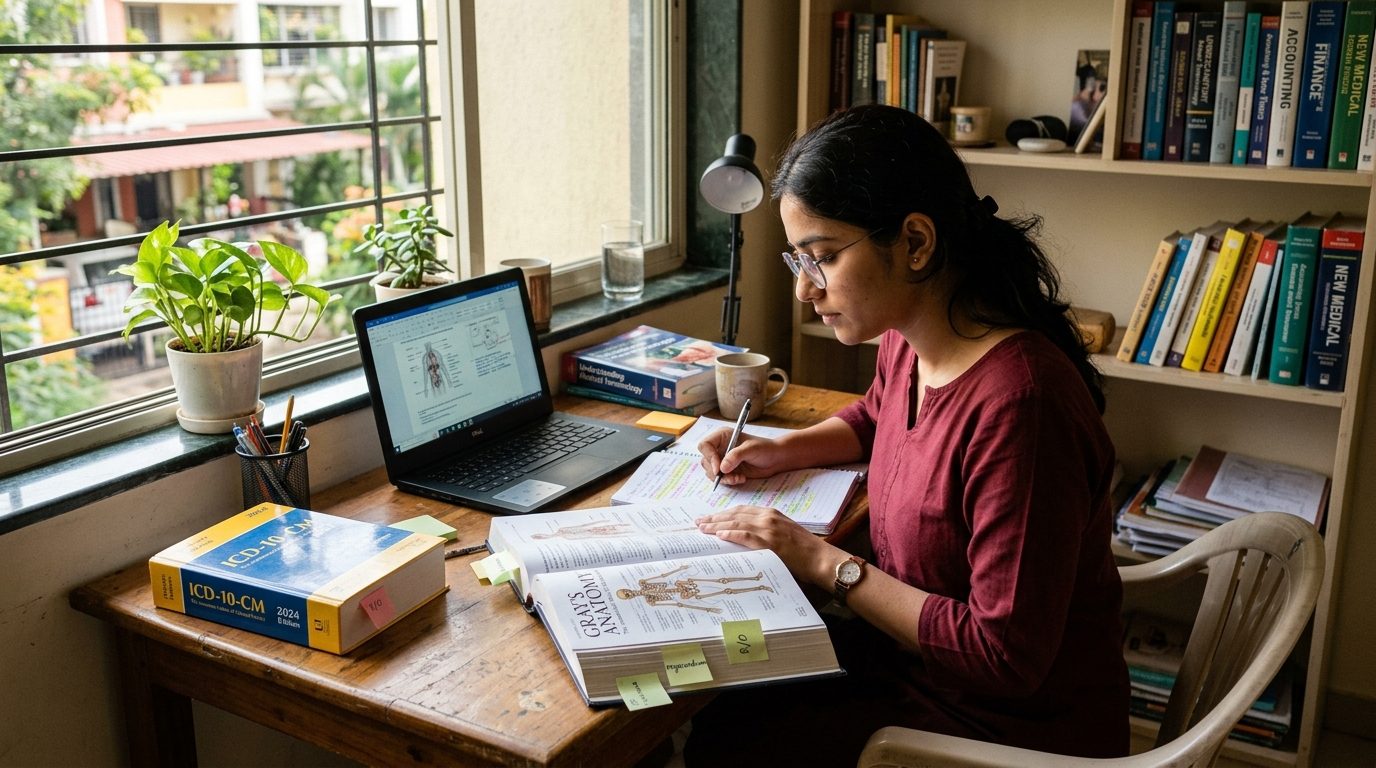
Table of Contents
"I graduated with a B.Com in accounting. Can I really become a certified medical coder, or is this career reserved only for doctors, nurses, and life science graduates?"
I get asked this exact question at least five times a week in my inbox. And I understand the fear behind it. When you first open an ICD-10-CM or CPT codebook, it looks like a foreign language written by alien surgeons. Terms like "choledocholithiasis," "salpingo-oophorectomy," and "anterolateral myocardial infarction" sound terrifying if the last biology class you sat through was in the 10th standard.
Here is the honest truth nobody in aggressive coaching institutes will tell you upfront: You do NOT need a degree in biology, pharmacy, or nursing to become a world-class medical coder. In fact, some of the fastest, most detail-oriented inpatient and HCC coders I know started their careers with degrees in commerce, literature, and computer applications.
Medical coding is fundamentally a system of structured logic, pattern recognition, and strict rule compliance. It is much closer to taxation or legal auditing than it is to performing open-heart surgery.
Let me break down the exact, realistic roadmap that thousands of non-biology graduates have used to transition into medical coding, pass their AAPC CPC or AHIMA CCS exams on the first attempt, and land solid healthcare revenue cycle jobs in 2026.
The 3 Medical Sciences You Actually Need (And What You Can Skip)
When non-science students panic, it is usually because they think they have to study five years of medical school curriculum. That is completely false. As a medical coder, your medical curriculum consists of exactly three targeted pillars:
1. Medical Terminology (The Root-Word Formula)
Medical language is not memorized word-for-word; it is assembled like Lego bricks. Almost every complex medical term consists of three basic components:
- Prefix (The Beginning): Indicates location, time, or number. Example: Sub- (under), Brady- (slow), Tachy- (fast).
- Root Word (The Core): Identifies the organ or body part. Example: Cardi/o (heart), Gastr/o (stomach), Nephr/o (kidney), Hepat/o (liver).
- Suffix (The Ending): Indicates condition, procedure, or disease. Example: -itis (inflammation), -ectomy (surgical removal), -scopy (visual inspection).
Once you learn the 50 most common prefixes, 75 root organs, and 30 suffixes, you can instantly decipher words you have never seen before in your life. If a chart says "Gastroenteritis," you break it down: Gastr- (stomach) + enter- (small intestine) + -itis (inflammation). Boom: inflammation of the stomach and intestines. No biology degree required.
2. Human Anatomy & Physiology (The Body Map)
You don't need to memorize cellular mitochondria or microscopic biochemistry. What you must understand is spatial layout, body systems, and functional pathways:
- Where are the chambers of the heart, and how does blood circulate?
- What are the different sections of the spine (Cervical, Thoracic, Lumbar, Sacral)?
- What is the difference between an open fracture and a closed fracture?
- What are the quadrants of the abdomen?
This is visual, spatial learning. A standard high school atlas or free YouTube medical animation channels give you 90% of what you need within four weeks of daily 45-minute study.
3. Pathophysiology (Disease Processes & Complications)
You need to understand what common chronic diseases do to the human body. When hypertension affects the kidneys, what does that condition get called? (Hypertensive chronic kidney disease). When diabetes causes nerve damage, how is it documented? (Diabetic peripheral neuropathy).
The 6-Month Zero-to-Job Transition Roadmap
Here is the realistic, field-tested timeline I recommend to anyone coming from an arts, commerce, BBA, BCA, or engineering background:
| Phase & Timeline | Focus Area | Daily Study Commitment | Key Milestone |
|---|---|---|---|
| Month 1: Foundation | Medical Terminology, Prefixes/Suffixes & Basic Anatomy Systems | 1.5 – 2 hours | Able to decode complex surgical notes without a dictionary. |
| Month 2: ICD-10-CM | Diagnosis Coding Rules, Alphabetic Index navigation, Tabular conventions | 2 – 2.5 hours | Master chapter-specific coding guidelines (Infections, Neoplasms, Diabetes). |
| Month 3: CPT & HCPCS | Procedure Coding, Evaluation & Management (E/M), Surgery section, Modifiers | 2.5 hours | Accurately assign procedure codes and apply Modifier 25, 59, and LT/RT. |
| Month 4: Codebook Mastery | Tabbing your manuals, cross-referencing notes, timing drills | 2.5 – 3 hours | Look up any complex code in under 90 seconds. |
| Month 5: Full Mock Exams | AAPC Practice Exams, Rationale analysis, weak area drills | 3 hours (timed tests) | Consistently scoring 80%+ on 100-question mock exams. |
| Month 6: Exam & Placement | Take the official CPC / CCS exam; Resume building and interview prep | 2 hours | Pass official credential and receive initial fresher job offers. |
Why Commerce and Math Students Often Outperform in Coding
I have trained hundreds of students across India and the US, and here is an ironic secret: commerce and IT graduates frequently pass their certification exams with higher scores than biology majors.
Why? Because biology students often rely on their medical assumptions. When a doctor writes an ambiguous note, a biology student might say, "Well, obviously the patient had pneumonia because they had cough and fever!" and they code pneumonia. But in medical coding, if it is not explicitly documented by the physician, you cannot code it. That is considered illegal fraud or upcoding.
Commerce and accounting students, on the other hand, are trained in double-entry bookkeeping and tax law. They follow strict, literal statutory rules. If the note says cough, they code cough (R05.9). They never assume. That conservative, audit-proof discipline is exactly what top healthcare BPOs and US hospital groups look for.
Real Success Story: From Arts Graduate to Team Lead
Let me share a quick story about my colleague, Priya. In 2021, Priya had completed her Bachelor of Arts in English Literature in Pune. She was working in general customer support earning ₹16,000 a month with irregular night shifts. Her parents were worried, and she felt stuck.
A friend told her about US medical coding. Priya's first reaction was: "Are you crazy? I ran away from biology after 10th grade!" But she decided to give it a shot. She spent four weeks learning medical terminology, bought an anatomy coloring book, and enrolled in a structured CPC preparation program.
Her literature background turned out to be her greatest superpower: she could read complex, messy 5-page doctor discharge summaries in minutes and catch subtle nuances that others missed. She passed her CPC exam with an 84% score on her very first try.
Today, Priya is a Senior Coding Auditor and Quality Lead at a top healthcare MNC in Pune, managing a team of 18 coders and earning well over ₹75,000 per month. Not once in five years has any US client or Indian employer asked why she didn't have a B.Sc in Biology.
The 4 Biggest Traps Non-Biology Freshers Must Avoid
- Relying on Institute "In-House" Certificates: Many small coaching centers tell students, "You don't need the expensive AAPC exam; our diploma is valid everywhere." That is an outright lie. As we highlighted in our guide to choosing a coding course, non-science graduates especially need the credibility of an official international credential like the CPC (AAPC) or CCS (AHIMA) to prove their competency.
- Memorizing Codes Instead of Guidelines: Do not try to memorize thousands of ICD or CPT numbers. The exam and your daily job are open-book! What you must master are the Official Guidelines for Coding and Reporting (OGCR).
- Skipping Timed Mock Tests: The CPC exam gives you roughly 2.4 minutes per question. If you don't build book-flipping muscle memory, you will run out of time regardless of how much theory you know.
- Neglecting Modifier Rules: Modifiers like 25, 59, and 76 are the number one source of claim denials. Make sure you read our dedicated deep dive on Mastering CPT Modifiers 25 & 59 early in your study journey.
Recommended Free & Affordable Starter Resources
If you want to test the waters before spending thousands of rupees on courses:
- Khan Academy & CrashCourse Anatomy: Free, engaging YouTube video series breaking down every body system into simple, 10-minute visual lessons.
- Des Moines University Free Medical Terminology Course: An outstanding free online module that teaches you prefixes, roots, and suffixes with interactive audio pronunciations.
- RCMCodex Practice Materials: Check our curated Medical Coding Study Materials & Practice Question Banks for step-by-step rationales tailored specifically for first-time exam takers.
- Our Beginner Primer: Read What Is Medical Coding? Complete Beginner's Guide to understand how claims flow through the hospital revenue cycle.
The Bottom Line
Don't let anyone convince you that your graduation degree limits your career potential. In the healthcare revenue cycle industry, your degree is just a piece of paper that qualifies you to sit for the credentialing exam.
What matters to employers is your accuracy rate, your speed in navigating official codebooks, your ethical integrity, and your commitment to continuous learning. If you dedicate 6 months of disciplined study following this roadmap, your non-biology background will not hold you back for a single second.
About Dr. Sarah Mitchell, CPC, CPMA, CCS
AAPC & AHIMA CredentialedDr. Sarah Mitchell is a senior healthcare compliance auditor and credentialed coding specialist (CPC, CPMA, CCS, AAPC Fellow) with over 14 years of clinical revenue cycle experience across hospital inpatient, outpatient, and multi-specialty physician practices. She specializes in surgical CPT modifiers, E/M documentation leveling, NCCI unbundling defense, and Medicare Part B compliance audits.
Reader Comments (0)
No approved comments. Be the first to share your thoughts!


